

Column: Progress, pushback and Indigenous rights

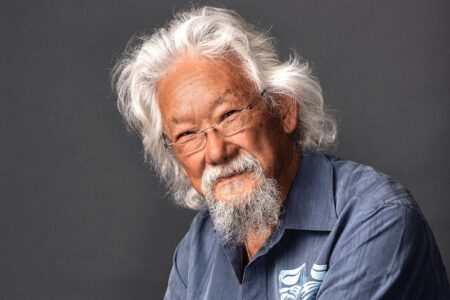
By David Suzuki

In Canada, progress on social and ecological justice often faces roadblocks.
When women got the right to vote here in 1918, organizations sprang up to argue voting was incompatible with women’s “traditional roles.”
When universal health care was introduced in the 1960s, doctors in Saskatchewan went on strike, accusing the government of exercising too much control over health care.
After Ontario passed a law in 1976 requiring motor vehicle occupants to wear seatbelts, other provinces and territories eventually followed suit. But the laws faced pushback, as a 1974 letter to the Toronto Star illustrates: “When I saw the editorial, on making everybody use seatbelts, I found it hard to believe my eyes. How easy it would be for us all if we could solve our problems in this way, just to make people do what you or I believe is good for them. Would you deny me this free choice of what risk I choose to assume?”
Laws against smoking in public places enacted from the late 1990s into the 2000s also faced backlash, with the hospitality industry arguing regulations would harm businesses such as restaurants and bars.
When provinces and the federal government introduced carbon pricing to reduce greenhouse gas emissions, the slogan “Axe the tax” gained momentum. Misinformation ignored federal rebates and the levy’s potential to significantly decrease Canada’s damaging contribution to climate change.
Big change creates uncertainty, which can be a legitimate concern and a lever used by those wishing to maintain power and/or profit. But, as seatbelt and smoking regulations — and many other examples — show, people eventually adapt. Uncertainty shouldn’t be used to frustrate progress.
Corporations and politicians are now trying to get Canada and British Columbia to walk back commitments to uphold Indigenous rights and obligations under the United Nations Declaration on the Rights of Indigenous Peoples.
The Kebaowek First Nation’s legal challenge against Canadian Nuclear Laboratories over a proposed nuclear waste facility near the Ottawa River illustrates how progress on Indigenous rights often meets resistance. In a landmark ruling, Justice Julie Blackhawk affirmed that Canada’s commitments under the UNDRIP must meaningfully inform federal decision-making. Canadian Nuclear Laboratories appealed the decision, arguing against application of the UN Declaration Act and the requirement to obtain free, prior and informed consent from Indigenous nations.
Uncertainty is also being used by opponents of Indigenous-led marine protected areas. They promote and leverage the fears and uncertainties of concerned small businesses while also opposing the interests of other small-scale operators, including recreational fishers, that support MPAs.
It’s a familiar refrain: Those with established power seek to prevent change, hiding behind the concerns and doubts of community members, but quickly turn on them when it’s in their interest to do so.
In Manitoba, pushback against a Parks Canada initiative to establish corridors to maintain or restore ecological connectivity is rooted in scare tactics about Indigenous governance, among other fears. At a standing committee on environment and sustainable development meeting in 2024, a policy adviser for the hunting and fishing advocacy group the Manitoba Wildlife Federation said, “When you turn management over to Parks Canada, to Indigenous protected areas or to different control mechanisms that are not by elected officials, how is there any accountability?”
Indigenous Peoples lived on these lands before European settlers arrived. Recent efforts to advance co-governance models and uphold Indigenous rights prior to extraction activities are meant to advance social justice and address the colonial legacies embedded in Canada’s history.
A recent joint letter from B.C. unions, academics, doctors and conservation organizations says, “We are deeply troubled by the recent rise in anti-Indigenous rhetoric and fearmongering in this province that has framed the realization of the fundamental human rights of Indigenous peoples as detrimental to economic growth, security, and the interests of others,” adding, “We believe that our futures are intertwined and our collective prosperity is inextricably linked.”
As the Yellowhead Institute states, “Aboriginal rights in Canadian law do not give Indigenous people rights — they merely recognize Crown obligations.” Indigenous people have inherent rights that are fundamental to treaty, human and constitutional rights.
We have a chance to do things right in Canada. Let’s put aside the fearmongering, push back against the pushback and continue our journey forward together.
David Suzuki is a scientist, broadcaster, author and co-founder of the David Suzuki Foundation. Written with David Suzuki Foundation Boreal Project Manager Rachel Plotkin.
Learn more at davidsuzuki.org.
















Comments